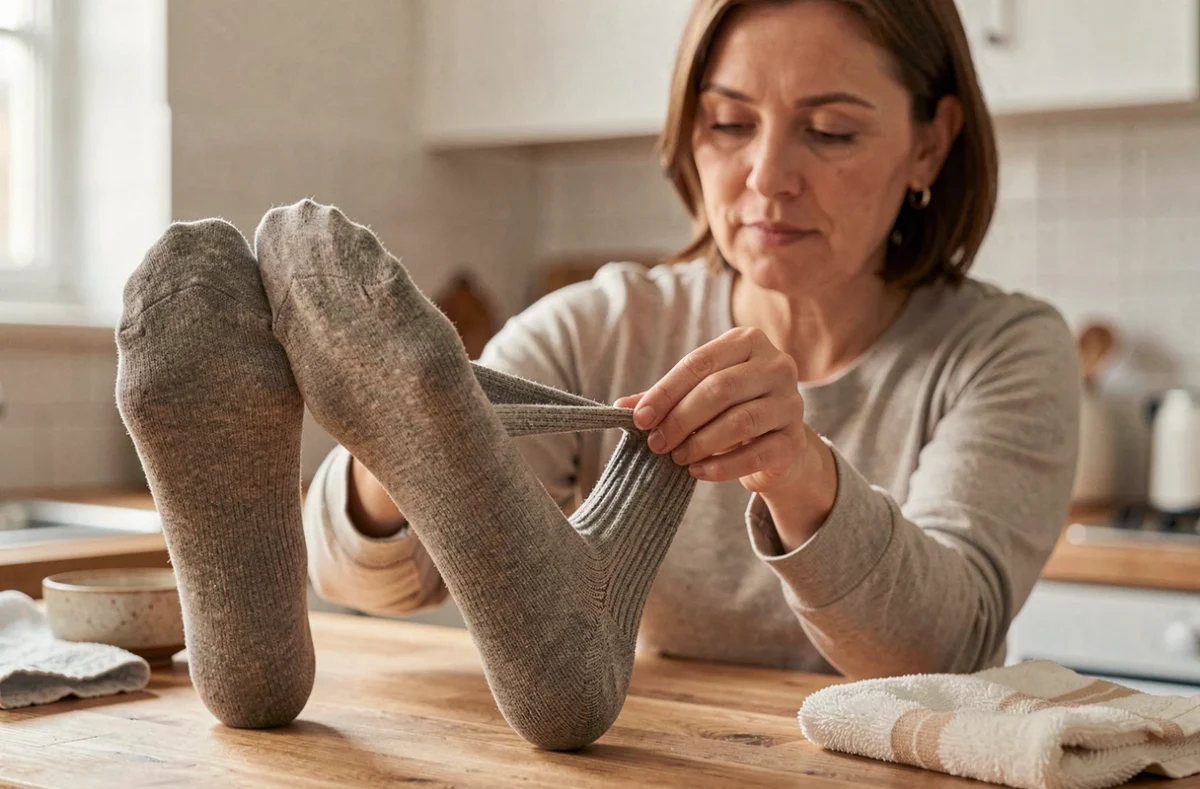
A sock that is too tight compresses the soft tissues of the foot and ankle, leaves elastic marks on the skin, and can hinder venous return. Before trying to stretch a pair, it is important to distinguish between two situations: a regular sock whose knit lacks flexibility, and a medical compression sock that is designed to be tight. Stretching techniques only apply to the first case.
For a compression sock, increasing pain, persistent tingling, numbness, or cold toes indicate a size or compression level issue, not a defect to be corrected on your own. The appropriate response is to remove the sock and reassess the model with a healthcare professional.
Elastane and heat: why your socks shrink in the wash
Most commercially available socks contain elastane (or Spandex), a synthetic fiber that provides elasticity to the knit. This fiber is sensitive to heat. A high-temperature tumble dry or too hot a wash can cause the elastane threads to contract, sometimes irreversibly.
Fabric softener can also damage elastic fibers. It leaves a film on the fabric that gradually stiffens the knit instead of softening it. Recent manufacturer recommendations advise against its use on socks containing elastane.
Checking the care label before any handling remains the most reliable reflex. Washing at a low temperature, without fabric softener and air drying preserves the original flexibility much longer. Several practical tips on Paris Avenue also detail the washing gestures suitable for each type of fiber.
Stretching tight socks: methods using lukewarm water and by hand
Manual stretching after washing is the most direct method to widen a regular sock without risking damage to the knit. The principle relies on the temporary plasticity of damp fibers.
Flat stretching after soaking
Soak the pair in lukewarm water (never hot) for about ten minutes. Gently squeeze without twisting, then lay each sock flat on a towel. Stretch the area of the upper edge and the foot laterally, holding the tension for a few seconds with each pass. Repeat the operation three or four times before allowing to air dry.
Lukewarm water softens the fibers without degrading the elastane, unlike boiling water which risks setting the deformation unevenly.
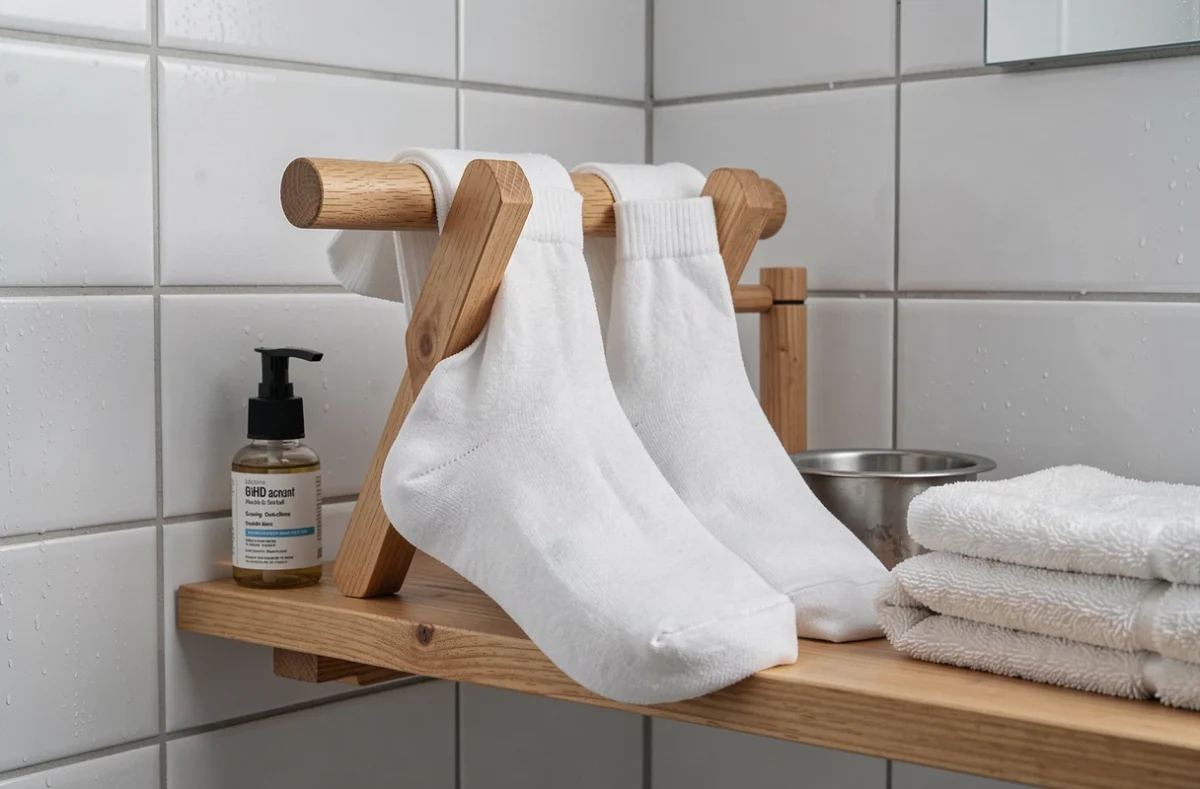
The plastic bottle technique
A tip shared by minimalist running communities involves inserting a narrow-necked plastic bottle into the damp sock. The bottle exerts constant and even pressure during drying, gradually widening the compressed area.
The choice of bottle matters: a diameter slightly larger than that of the targeted calf or ankle forces the knit without tearing it. Allowing the sock to dry on the bottle for several hours yields a more durable result than a brief manual stretch.
Too tight elastic cuff: when stretching is not enough
The problem does not always stem from the overall size of the sock. Often, it is the upper cuff that compresses, because the elastic there is denser or the knit is tighter.
A cuff that rolls on itself worsens the situation. This rolling concentrates pressure on a narrow band of skin, creating a localized tourniquet effect. Specialized recommendations advise against folding or rolling the upper part of a sock to try to make it more comfortable: this increases compression instead of reducing it.
If the cuff remains uncomfortable after several stretches, switching to a model with a wider cuff and a softer elastic is often the most effective response. Some manufacturers offer non-compressive cuff socks designed for people sensitive to elastic marks or suffering from mild circulatory issues.
Choosing the right material and size to avoid tight socks
Widening a sock corrects a symptom. Choosing the right pair from the start eliminates the problem at its source. Several criteria deserve attention:
- The textile composition: cotton-elastane blends offer a good compromise between support and flexibility, but the percentages vary. A lower elastane percentage results in a less compressive knit from the outset.
- The construction of the cuff: a wide ribbed cuff distributes pressure better than a thin, tight elastic. Check the width of the cuff before purchase.
- The actual size of the foot: manufacturers’ size guides are based on shoe size, but foot width and ankle circumference matter just as much. A wide foot in a sock designed for a narrow foot will always be compressed, regardless of shoe size.
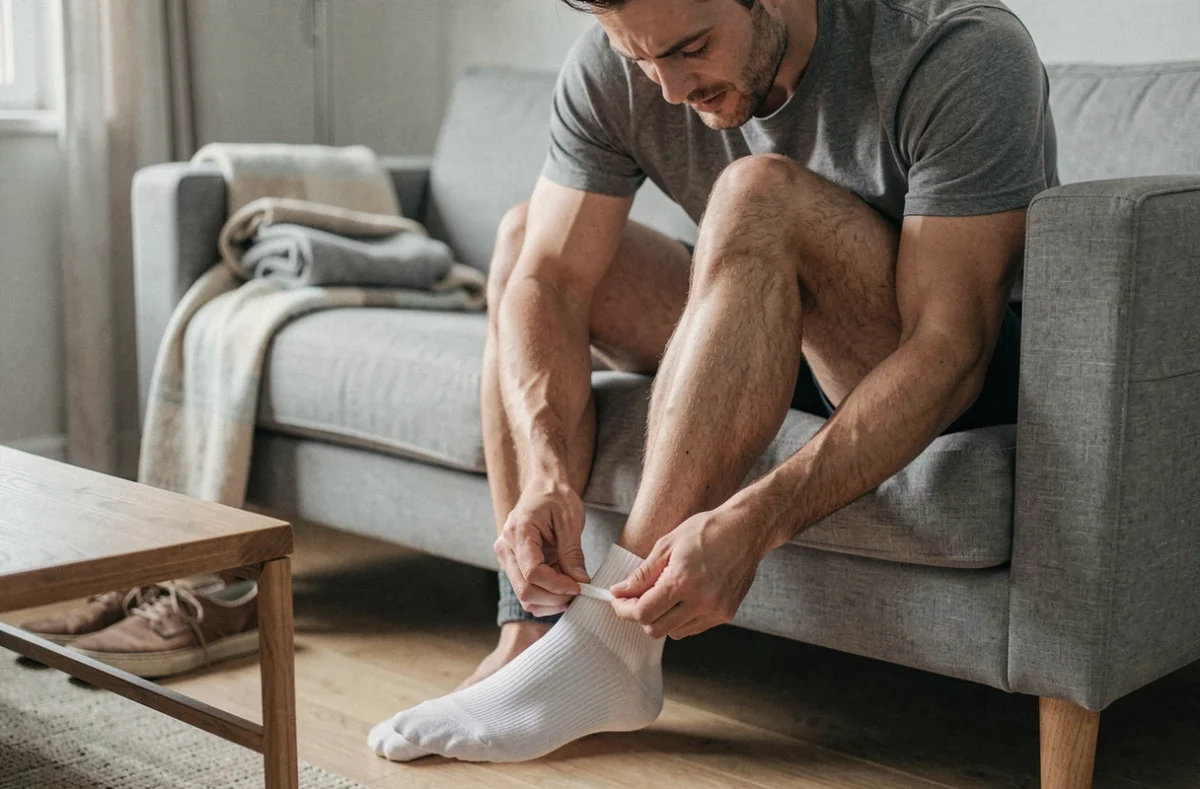
Feet naturally swell throughout the day due to heat and standing. Trying on socks in the morning, when the foot is at its minimal volume, can skew the assessment of comfort.
What to remember before stretching your socks
Lukewarm water stretching and the bottle technique work on regular socks whose knit has simply shrunk in the wash. These methods are not suitable for medical compression socks, which require professional fitting.
- Always check the care label before handling the fabric.
- Avoid high-temperature tumble drying and fabric softener to preserve elastane.
- If the cuff rolls and creates a tourniquet, do not fold it further: switch to a model with a wide cuff.
- Prefer trying on at the end of the day, when the foot is at its maximum volume.
A sock that is tight despite the correct size indicates a construction defect, not a foot problem. Adapting washing habits and purchasing criteria significantly reduces the risk of needing to stretch anything.